SSSAD X TRANSCRIPTS
CHRISTINE X EMILY
“Christine Wong Yap has been a long-time inspiration to me because of her artistic and activist vision. She tells the stories of AAPI women and people of color with such care and boldness. I particularly love the way her work occupies physical space—a gallery, parade, or storefront—making AAPI narratives tangible and impossible to unsee.”
- Emily
she/they

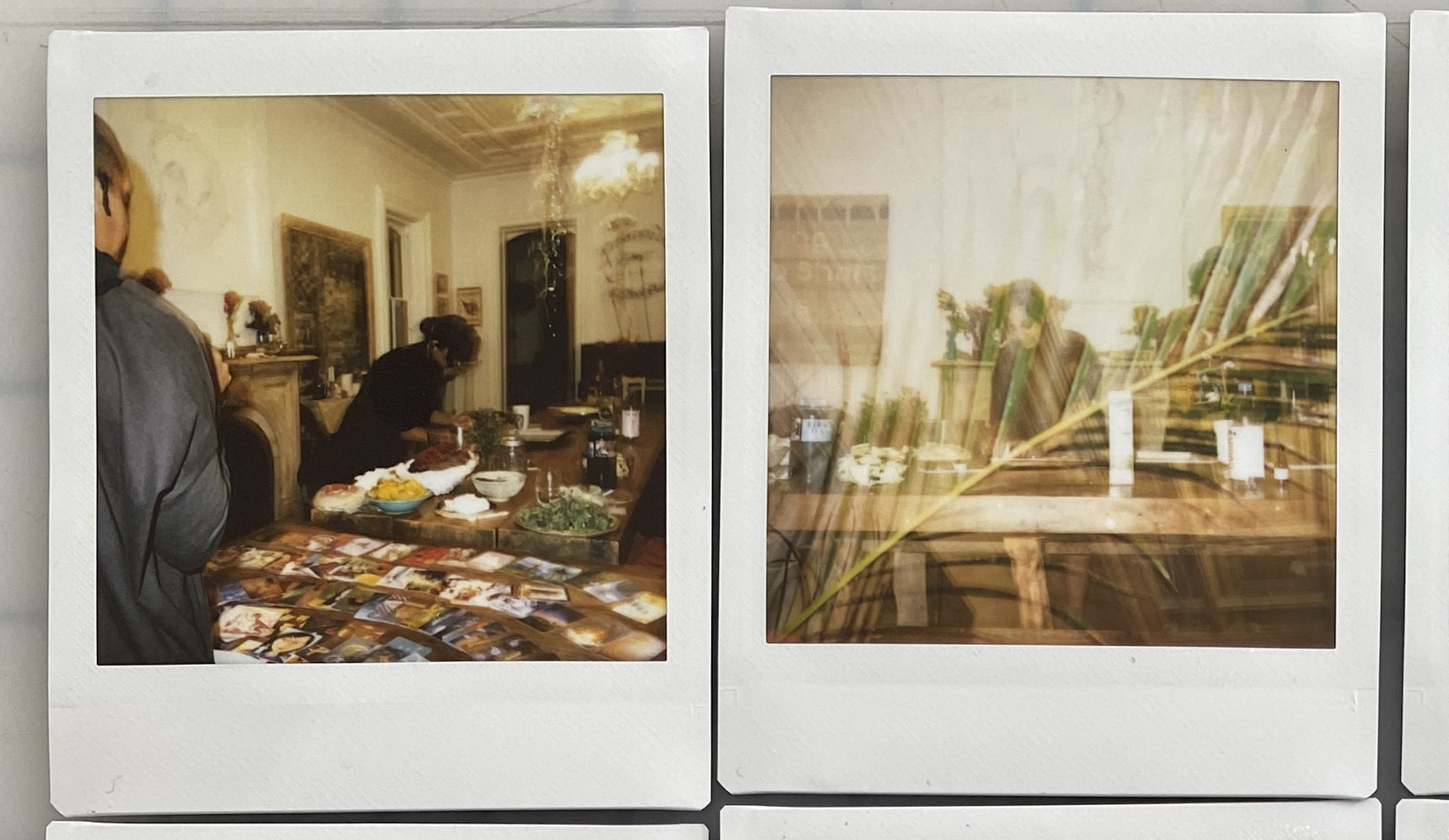

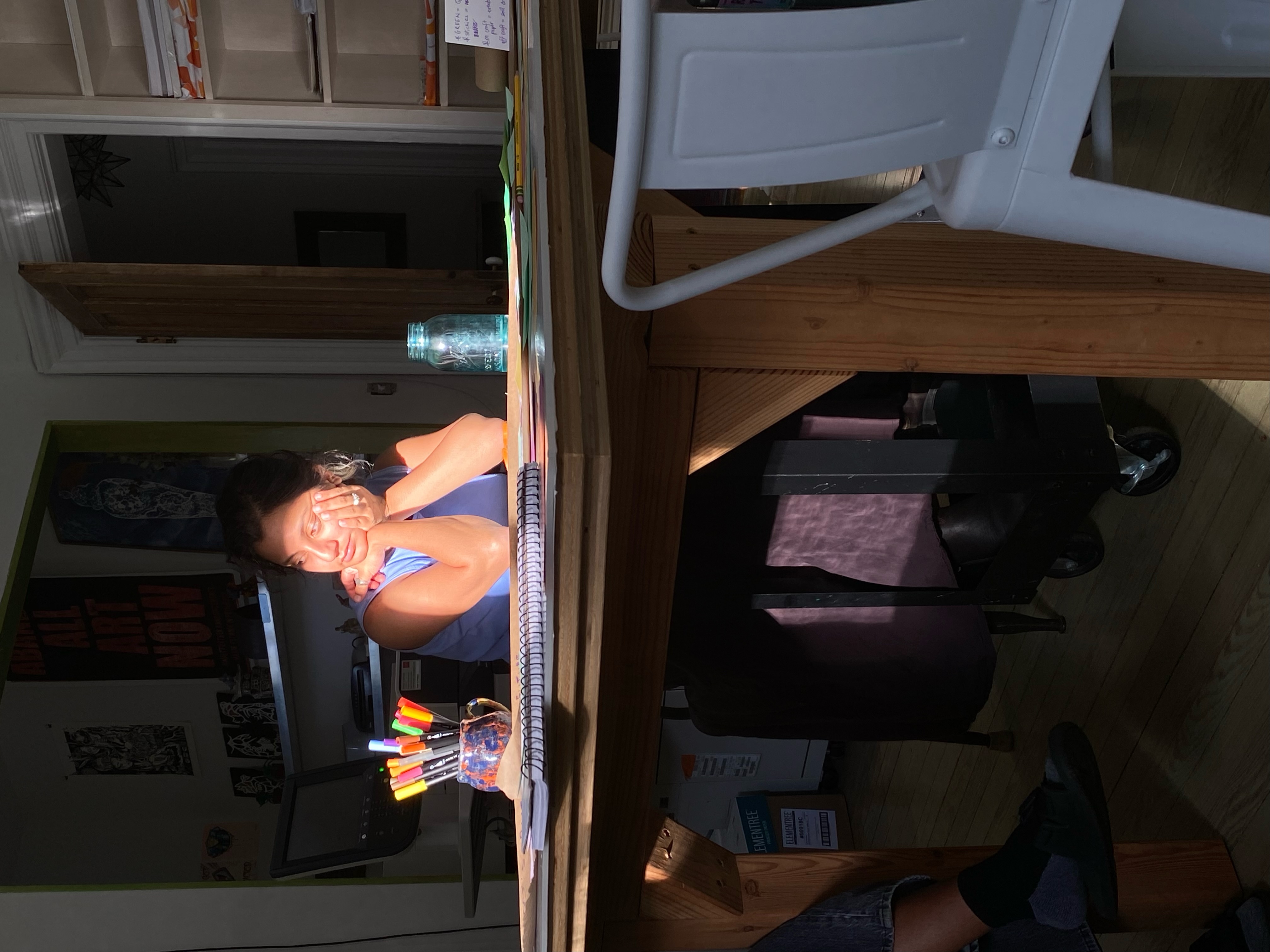

This transcript has been edited for clarity.
Emily Pilloton-Lam (EPL): I’m Emily Pilloton-Lam, and I’m here with Christine Wong Yap, and it is Wednesday, April 16th. Thank you so much again for all your time. We can just jump right in. So I’ll read you the first question and we can just sort of talk freely.
The first one is, Tell me about your experience growing up as Asian American, or insert whatever defining term you want to use. In what ways did you feel connected or disconnected to your ancestral home?
Christine Wong Yap (CWY): Great, thank you. Thanks so much for having me and asking me these great questions. I’m glad to be able to share any perspectives that might be interesting or worthwhile for anybody. I grew up in Northern California in kind of an agricultural area that was not very diverse. Both my parents are immigrants. The place where I grew up had a very all-American vibe. It had a small-town vibe, so there was a lot of pressure to assimilate. But, within the house, my parents were very traditional, and so that was a really big generational gap for me just to try to bridge who they wanted to be and who I felt like I wanted to be at the time. So I felt pretty distant from my identity, even though it was very much alive in my home. But I also felt a lot of—for me to be me, I had to escape it.
But then, later, I had the really good fortune of learning about this program called the Roots Program, which was at the time run at Chinese Culture Center in San Francisco. So, in my early twenties, I joined the program, and I got to learn about Chinese history from Him Mark Lai, the amazing Chinese American historian. And then, on top of that, there was a trip where it was a small cohort, probably like ten of us, and we got to visit our ancestral villages in the Pearl River Delta region. It’s a really amazing program. It only existed for a little while. I think it might still be going on, but it’s no longer at Chinese Culture Center. It was the only program of its kind that helped American-born Chinese go back to their ancestral villages.
And it’s actually a really difficult thing to go back to your ancestral villages. Some people don’t really—some parents don’t want to talk about their villages. Sometimes there’s some trauma there. My mom was born in Vietnam, so she hadn’t even been to her ancestral village, where her parents had migrated from. So it was a huge feat logistically just to get us there. But I think I spent two weeks in China, and it was very life-changing for me, and it really gave me a sense of what my parents’ lives were like or what my dad went through when he was living in mainland before he had to escape to Hong Kong. Just the culture and the places that really shaped my parents, and it really changed my relationship with them and my sense of identity, my relationship with being Chinese and Asian.
EPL: Wow. How old were you when you went on that trip?
CWY: It was in my early twenties, so I want to say twenty-two or twenty-three.
EPL: Wow. Yeah, it’s so interesting. I’ve only had a couple of these conversations, and even just talking to Tonia about my own story, it feels like a lot of us have that sense of being torn between two things as a child. I also grew up in a pretty much all-white community. I was the only non-white kid in my classes until I was, I think, tenth grade. So, yeah, just feeling so bifurcated in that way. And then I had a similar experience—unfortunately it was not back to China—but when I was sixteen, I had a similar awakening around identity.
That’s so beautiful. I wish that program were more readily available. Were there people that went on that trip who maybe didn’t even know where their ancestral villages were, and then was there a way that they were able to find them?
CWY: Oh, I think in my cohort there wasn’t, but there were people from other years where I think the older generation deliberately tried to lie or hide their village. There was something where—oh, there’s some shame or something where they were trying to not help their descendants reach their village.
EPL: Oh my gosh. Yeah. My grandparents came over, and there’s a lot of records that are conflicting about where they actually are from. My grandmother is from a lot of different places, and I don’t even know where I would go. It’s interesting.
CWY: There’s a lot of that in our community, and it’s really crazy. I think it’s hard for other people to understand. My mom, only a few years ago, told me—so both my parents are immigrants. I was just like, “I’m a child of immigrants,” even though I knew that my grandpa had lived here before. And then he went back to the village and had a wife there, but he also lived over here. But then it was only recently that my mom told me that she understood that my dad’s side of the family goes back several generations in America, which is crazy. And I was like, Oh, there must’ve been some Chinese exclusion impact there. We weren’t able to have wives over here and all this stuff, but I have no idea if it was my great grandparents or even another generation before that.
EPL: Wow. It’s never simple. Thanks for sharing that.
Okay, so the second one is how would you describe your work? How has your upbringing and identity shaped your creative path and the way you approach your work?
CWY: I’m a visual artist and social practitioner. I have explored a lot of themes around belonging, mental wellbeing, and resilience. My work takes a lot of different forms. I like to use common forms. I like for my work to be pretty accessible, so I’ve made things like banners and flags. As part of that, I was able to lead a cohort of sixteen immigrant women, half Chinese, half Latinx, in the Chinese New Year parade, carrying our banners that we designed. I also do a lot of lettering and text-based art. I’m a printmaker, so I’ve done letterpress, and I also make publications and have also made quite a few public artworks as well.
And how my identity has played into this is—I started out as a printmaker, and for me, I was attracted to the work of artists like José Guadalupe Posada, who is known for his skeleton figures. A lot of the works are about making fun of the rich, and they’re cool because there’s a European tradition of printmaking where it’s all about, I’m going make twenty etchings and then I’m going to kill the plate, and then I can make the price of the etching higher. So it’s this idea of artificial scarcity.
José Guadalupe Posada would just make tons and tons and tons of prints and sell them for cheap. And then he often had a poem or song underneath and then an illustration up top. And that was partly because not everybody could read. So it’s a very different model of dissemination, of decentralization, of access. So that was why I was attracted to printmaking.
And then I went to grad school, and I started making installations that were about people’s perceptions, about the viewer’s perceptions in the space about their optimism or pessimism. And then I kind of realized, Oh, instead of just making these obtuse ways of learning about what people think, I can actually just do that directly. So that’s kind of how I ended up doing social practice work, which is very much about community engagement. And also I was doing a lot of activism work in my early twenties, so I was doing a lot of teaching arts and community arts back then. And I think that also helped me have a grounding of popular education and that kind of liberation pedagogy that I use in my workshops now.
So my work has kind of come full circle in that I moved to New York for ten years, and I moved back to be closer to my mom, who was getting older, and then I was one of her primary caretakers. She’s monolingual, even though she was always an English language learner, but I could see how when we would go out to a space, if there were translations available, how much her experience improved.
So then I started to do more work around language access, and especially after 2017 with Trump’s Muslim ban, I started to think a lot about belonging. And then I think the work with belonging and making my work more accessible in terms of language has really helped my direction. It’s who I am as an artist, what I want to do as a social practitioner, and really trying to figure out how to make the work more accessible, but also how to not just engage different groups of people one time, but engage a smaller group of people over time to develop deeper relationships.
EPL: Wow. I think I mentioned my partner is Mexican, and I am fluent in Spanish as well. And I’ve always sort of had—and through our relationship—have this sort of innate connection to many Latino cultures, specifically Mexican and specifically through art. I love that you drew so much inspiration from Posada because—it’s not subtle. It’s like, I’m going to make a million of these. The art is very—it’s clear what the message is, and I just feel like there’s such an affinity between so many Asian identities and stories and some of the Latinx and Latinx immigrant stories. So I love that you’ve made that connection as well.
Just a real quick follow-up, one of the reasons we have shown your work so many times in our Protest and Print classes, I do feel like it embodies that story of belonging but in a very activist way without hitting you over the head with it. And so I think, yeah, I’m just curious—you said in your twenties you’re doing more activist work—do you identify as an activist or different related word? And how do you feel like that has sort of evolved over the arc of your work, especially given the most recent, let’s say last ten years?
CWY: Oh, that’s a really good question. I think my twenties, I definitely identified very strongly as an activist. I was involved in a lot of youth justice and criminal justice stuff around ending the prison industrial complex. I was painting murals and stuff that could be used at protests. And I think my work shifted—well, going to grad school, my work definitely shifted to be a little bit less overt. And then it’s gotten more kind of direct and didactic over the years just because I’m working with other people’s words often, and I try to not do too much interpretation as far as their actual words, trying to just maintain their voice, and out of respect.
And I think now, my work as a social practitioner, I am trying to be really community rooted, and I’m trying to design this program that there’s a bunch of aesthetic decisions that go into it. And some of those aesthetics are driven by ethics and politics. I could choose to work with anybody, but I really am choosing to work with working-class immigrant Chinese and Latinx women who have limited access to the arts, who have limited English proficiency. That’s all driven by political stuff, and especially now—in 2025.
But also I also want them to feel like they can talk about what they want to talk about. I’m not going to drive them into certain messages or what they need to say or should say. But I’m finding that they’re already active in their communities in a lot of ways. I did a previous project with them, which was just about resilience, which could have been about their own personal experiences. And some people talked about social political things like organizing with a group of other domestic workers and a worker coalition. And so actually this new project that I’m doing with them is going to be explicitly more about that kind of stuff. How did they end up wanting to do this kind of work in their communities based on their experiences as immigrants?
EPL: That’s such a beautiful form of activism too—passing the mic or bringing others into the messaging instead of just being the person with the bullhorn all the time. It’s a very joyful and democratic way of being an activist rather than just shouting from a place of anger. So I’ve always really admired that about your work.
And then the last question is, What dreams and aspirations do you have for Asian and Asian diasporic spaces and the people who are shaping them through art or design?
CWY: Thank you. I love that question. So, a few years ago, I did a project in San Francisco, Chinatown and Manilatown, and I asked people, What are their hopes and dreams for Chinatown? And somebody said something like, “Oh, I hope for the generations of love and care to continue.” And I think places like San Francisco Chinatown are so constantly endangered of gentrification that just the idea of preservation of a space where low-income seniors can live, where kids can be newcomers in a school that has bilingual education, things that open the door to a sense of belonging. So I really always think about that.
But I also really love how places like Chinese Culture Center and other spaces like grassroots organizations are doing a lot of coalition building and also stepping up with saying, We’re not just here to serve Chinese Americans in Chinatown, but during, I think in 2020, they had a pretty big Black Lives Matter takeover in Chinatown where they just had all this painting and chalk paint on the ground and helping to bring issues to the community and maybe build some political education and awareness there. I think right now they’re about to start their queer Chinatown Pride Month, which I think is so cool just to highlight—Chinatown has always been a queer place. And just to challenge the idea of, I think there’s a lot of assumptions that Chinese people in America are middle class and socially conservative, but actually pointing out all these ways where just walking alongside people, bringing people along, and also seeing, no, historically, we’ve also had Wong Kim Ark in our history of the person who helped solidify the Fourteenth Amendment and birthright citizenship.
EPL: I have felt, just as a person living across the Bay, that San Francisco Chinatown in the past five to ten years has become really intersectional and exciting and youthful, and there’s so many incredible things happening there that, as you said, are not the sort of monolithic identity that a lot of people associate with being Chinese. It feels like a really exciting place with exciting spaces and a lot of really cool new art entities—and vibrant in a way that—I grew up going there as a kid, and I was a kid, so I wasn’t looking at it in this way, but I don’t remember it feeling as culturally exciting and cutting edge.
CWY: Oh, cool! That’s great!
EPL: Amazing. Well, those are the three questions. Is there anything else that you want to add or ask? It could be anything.
CWY: I think for the second question I forgot to mention—I got really into positive psychology maybe about fifteen years ago. And coming out of grad school, I was interested in optimism and pessimism, and I was like, Why don’t I just study what psychologists actually say? And then learning that optimism is a skill learnable was really helpful for me. And then, only in retrospect much later, I realized my parents went through so much. My dad was adopted by a family of nationalists. So, during the Cultural Revolution, he was sent away to go to boarding school in Hong Kong because living in mainland China was not necessarily the safest for him. My mom was born in Vietnam. She escaped the American War in Vietnam. So both of them had these legacies of trauma. And the household where I grew up in—perfectionism was a very common norm, as well as anxiety and control. (laughs) And then I realized, of course, I would be attracted to positive psychology where you can learn skills like cognitive behavioral therapy to manage your anxiety and to not just want to survive but actually have very healthful relationships where you can deal with conflict instead of shutting it down with shame.
So, I think, just seeing how your life and your art is more related than you might even understand while it’s happening is also pretty cool. So, when you mentioned my posters and stuff are not just shouting at people with a bullhorn, I think a lot of my work comes from this place of wanting to affirm the positive.
EPL: You can totally feel that. I feel the same way about the work at Girls’ Garage. There’s a lot to be pissed off about, and everyone is pissed off. Let’s just assume that is true. And yet I feel like the things that connect us the most are coming from that place of, Yes, we’re angry and here’s this beautiful thing I’m reflecting on that’s going to connect me to other people rather than push people away. And so much of that work is personal and is psychological and therapy-driven and trauma-based.
As you were doing that work with positive psychology, did you share any of that with your parents or have conversations with them that you feel like they were interested or receptive to?
CWY: I don’t think I was able to share too much with my dad. He passed away in 2012, and I was just starting to do some of that inquiry. With my mom, I was able to share more, and I heard some really great advice from a podcast with therapists about—with parents, they might resist verbally, but then if you can see the changes in their behaviors later, just take that as like, Okay, they are hearing you. And I think over time, just talking with my mom about boundaries, she started to learn more about like, Oh, okay, I got to be responsible for this part, and then I can ask you for this part. And it’s not an imposition or something.
EPL: Yeah. My parents are not—well, my father is an immigrant, but my mother, who’s Chinese, is not and has a different category of childhood experience that I don’t know that she would designate as trauma, but it’s definitely a story of growing up outside of Chicago and the pressures of assimilation and being the only Chinese kid. And it’s just been interesting to, as you said, reflect on my own experience and then relate that to hers and try to somehow bond over that without forcing her into a place of shame or questioning. Yeah, so interesting.
Wow. Thank you so, so much. I really love learning more about your story, and it makes me love your work even more.
Emily Pilloton-Lam (EPL): I’m Emily Pilloton-Lam, and I’m here with Christine Wong Yap, and it is Wednesday, April 16th. Thank you so much again for all your time. We can just jump right in. So I’ll read you the first question and we can just sort of talk freely.
The first one is, Tell me about your experience growing up as Asian American, or insert whatever defining term you want to use. In what ways did you feel connected or disconnected to your ancestral home?
Christine Wong Yap (CWY): Great, thank you. Thanks so much for having me and asking me these great questions. I’m glad to be able to share any perspectives that might be interesting or worthwhile for anybody. I grew up in Northern California in kind of an agricultural area that was not very diverse. Both my parents are immigrants. The place where I grew up had a very all-American vibe. It had a small-town vibe, so there was a lot of pressure to assimilate. But, within the house, my parents were very traditional, and so that was a really big generational gap for me just to try to bridge who they wanted to be and who I felt like I wanted to be at the time. So I felt pretty distant from my identity, even though it was very much alive in my home. But I also felt a lot of—for me to be me, I had to escape it.
But then, later, I had the really good fortune of learning about this program called the Roots Program, which was at the time run at Chinese Culture Center in San Francisco. So, in my early twenties, I joined the program, and I got to learn about Chinese history from Him Mark Lai, the amazing Chinese American historian. And then, on top of that, there was a trip where it was a small cohort, probably like ten of us, and we got to visit our ancestral villages in the Pearl River Delta region. It’s a really amazing program. It only existed for a little while. I think it might still be going on, but it’s no longer at Chinese Culture Center. It was the only program of its kind that helped American-born Chinese go back to their ancestral villages.
And it’s actually a really difficult thing to go back to your ancestral villages. Some people don’t really—some parents don’t want to talk about their villages. Sometimes there’s some trauma there. My mom was born in Vietnam, so she hadn’t even been to her ancestral village, where her parents had migrated from. So it was a huge feat logistically just to get us there. But I think I spent two weeks in China, and it was very life-changing for me, and it really gave me a sense of what my parents’ lives were like or what my dad went through when he was living in mainland before he had to escape to Hong Kong. Just the culture and the places that really shaped my parents, and it really changed my relationship with them and my sense of identity, my relationship with being Chinese and Asian.
EPL: Wow. How old were you when you went on that trip?
CWY: It was in my early twenties, so I want to say twenty-two or twenty-three.
EPL: Wow. Yeah, it’s so interesting. I’ve only had a couple of these conversations, and even just talking to Tonia about my own story, it feels like a lot of us have that sense of being torn between two things as a child. I also grew up in a pretty much all-white community. I was the only non-white kid in my classes until I was, I think, tenth grade. So, yeah, just feeling so bifurcated in that way. And then I had a similar experience—unfortunately it was not back to China—but when I was sixteen, I had a similar awakening around identity.
That’s so beautiful. I wish that program were more readily available. Were there people that went on that trip who maybe didn’t even know where their ancestral villages were, and then was there a way that they were able to find them?
CWY: Oh, I think in my cohort there wasn’t, but there were people from other years where I think the older generation deliberately tried to lie or hide their village. There was something where—oh, there’s some shame or something where they were trying to not help their descendants reach their village.
EPL: Oh my gosh. Yeah. My grandparents came over, and there’s a lot of records that are conflicting about where they actually are from. My grandmother is from a lot of different places, and I don’t even know where I would go. It’s interesting.
CWY: There’s a lot of that in our community, and it’s really crazy. I think it’s hard for other people to understand. My mom, only a few years ago, told me—so both my parents are immigrants. I was just like, “I’m a child of immigrants,” even though I knew that my grandpa had lived here before. And then he went back to the village and had a wife there, but he also lived over here. But then it was only recently that my mom told me that she understood that my dad’s side of the family goes back several generations in America, which is crazy. And I was like, Oh, there must’ve been some Chinese exclusion impact there. We weren’t able to have wives over here and all this stuff, but I have no idea if it was my great grandparents or even another generation before that.
EPL: Wow. It’s never simple. Thanks for sharing that.
Okay, so the second one is how would you describe your work? How has your upbringing and identity shaped your creative path and the way you approach your work?
CWY: I’m a visual artist and social practitioner. I have explored a lot of themes around belonging, mental wellbeing, and resilience. My work takes a lot of different forms. I like to use common forms. I like for my work to be pretty accessible, so I’ve made things like banners and flags. As part of that, I was able to lead a cohort of sixteen immigrant women, half Chinese, half Latinx, in the Chinese New Year parade, carrying our banners that we designed. I also do a lot of lettering and text-based art. I’m a printmaker, so I’ve done letterpress, and I also make publications and have also made quite a few public artworks as well.
And how my identity has played into this is—I started out as a printmaker, and for me, I was attracted to the work of artists like José Guadalupe Posada, who is known for his skeleton figures. A lot of the works are about making fun of the rich, and they’re cool because there’s a European tradition of printmaking where it’s all about, I’m going make twenty etchings and then I’m going to kill the plate, and then I can make the price of the etching higher. So it’s this idea of artificial scarcity.
José Guadalupe Posada would just make tons and tons and tons of prints and sell them for cheap. And then he often had a poem or song underneath and then an illustration up top. And that was partly because not everybody could read. So it’s a very different model of dissemination, of decentralization, of access. So that was why I was attracted to printmaking.
And then I went to grad school, and I started making installations that were about people’s perceptions, about the viewer’s perceptions in the space about their optimism or pessimism. And then I kind of realized, Oh, instead of just making these obtuse ways of learning about what people think, I can actually just do that directly. So that’s kind of how I ended up doing social practice work, which is very much about community engagement. And also I was doing a lot of activism work in my early twenties, so I was doing a lot of teaching arts and community arts back then. And I think that also helped me have a grounding of popular education and that kind of liberation pedagogy that I use in my workshops now.
So my work has kind of come full circle in that I moved to New York for ten years, and I moved back to be closer to my mom, who was getting older, and then I was one of her primary caretakers. She’s monolingual, even though she was always an English language learner, but I could see how when we would go out to a space, if there were translations available, how much her experience improved.
So then I started to do more work around language access, and especially after 2017 with Trump’s Muslim ban, I started to think a lot about belonging. And then I think the work with belonging and making my work more accessible in terms of language has really helped my direction. It’s who I am as an artist, what I want to do as a social practitioner, and really trying to figure out how to make the work more accessible, but also how to not just engage different groups of people one time, but engage a smaller group of people over time to develop deeper relationships.
EPL: Wow. I think I mentioned my partner is Mexican, and I am fluent in Spanish as well. And I’ve always sort of had—and through our relationship—have this sort of innate connection to many Latino cultures, specifically Mexican and specifically through art. I love that you drew so much inspiration from Posada because—it’s not subtle. It’s like, I’m going to make a million of these. The art is very—it’s clear what the message is, and I just feel like there’s such an affinity between so many Asian identities and stories and some of the Latinx and Latinx immigrant stories. So I love that you’ve made that connection as well.
Just a real quick follow-up, one of the reasons we have shown your work so many times in our Protest and Print classes, I do feel like it embodies that story of belonging but in a very activist way without hitting you over the head with it. And so I think, yeah, I’m just curious—you said in your twenties you’re doing more activist work—do you identify as an activist or different related word? And how do you feel like that has sort of evolved over the arc of your work, especially given the most recent, let’s say last ten years?
CWY: Oh, that’s a really good question. I think my twenties, I definitely identified very strongly as an activist. I was involved in a lot of youth justice and criminal justice stuff around ending the prison industrial complex. I was painting murals and stuff that could be used at protests. And I think my work shifted—well, going to grad school, my work definitely shifted to be a little bit less overt. And then it’s gotten more kind of direct and didactic over the years just because I’m working with other people’s words often, and I try to not do too much interpretation as far as their actual words, trying to just maintain their voice, and out of respect.
And I think now, my work as a social practitioner, I am trying to be really community rooted, and I’m trying to design this program that there’s a bunch of aesthetic decisions that go into it. And some of those aesthetics are driven by ethics and politics. I could choose to work with anybody, but I really am choosing to work with working-class immigrant Chinese and Latinx women who have limited access to the arts, who have limited English proficiency. That’s all driven by political stuff, and especially now—in 2025.
But also I also want them to feel like they can talk about what they want to talk about. I’m not going to drive them into certain messages or what they need to say or should say. But I’m finding that they’re already active in their communities in a lot of ways. I did a previous project with them, which was just about resilience, which could have been about their own personal experiences. And some people talked about social political things like organizing with a group of other domestic workers and a worker coalition. And so actually this new project that I’m doing with them is going to be explicitly more about that kind of stuff. How did they end up wanting to do this kind of work in their communities based on their experiences as immigrants?
EPL: That’s such a beautiful form of activism too—passing the mic or bringing others into the messaging instead of just being the person with the bullhorn all the time. It’s a very joyful and democratic way of being an activist rather than just shouting from a place of anger. So I’ve always really admired that about your work.
And then the last question is, What dreams and aspirations do you have for Asian and Asian diasporic spaces and the people who are shaping them through art or design?
CWY: Thank you. I love that question. So, a few years ago, I did a project in San Francisco, Chinatown and Manilatown, and I asked people, What are their hopes and dreams for Chinatown? And somebody said something like, “Oh, I hope for the generations of love and care to continue.” And I think places like San Francisco Chinatown are so constantly endangered of gentrification that just the idea of preservation of a space where low-income seniors can live, where kids can be newcomers in a school that has bilingual education, things that open the door to a sense of belonging. So I really always think about that.
But I also really love how places like Chinese Culture Center and other spaces like grassroots organizations are doing a lot of coalition building and also stepping up with saying, We’re not just here to serve Chinese Americans in Chinatown, but during, I think in 2020, they had a pretty big Black Lives Matter takeover in Chinatown where they just had all this painting and chalk paint on the ground and helping to bring issues to the community and maybe build some political education and awareness there. I think right now they’re about to start their queer Chinatown Pride Month, which I think is so cool just to highlight—Chinatown has always been a queer place. And just to challenge the idea of, I think there’s a lot of assumptions that Chinese people in America are middle class and socially conservative, but actually pointing out all these ways where just walking alongside people, bringing people along, and also seeing, no, historically, we’ve also had Wong Kim Ark in our history of the person who helped solidify the Fourteenth Amendment and birthright citizenship.
EPL: I have felt, just as a person living across the Bay, that San Francisco Chinatown in the past five to ten years has become really intersectional and exciting and youthful, and there’s so many incredible things happening there that, as you said, are not the sort of monolithic identity that a lot of people associate with being Chinese. It feels like a really exciting place with exciting spaces and a lot of really cool new art entities—and vibrant in a way that—I grew up going there as a kid, and I was a kid, so I wasn’t looking at it in this way, but I don’t remember it feeling as culturally exciting and cutting edge.
CWY: Oh, cool! That’s great!
EPL: Amazing. Well, those are the three questions. Is there anything else that you want to add or ask? It could be anything.
CWY: I think for the second question I forgot to mention—I got really into positive psychology maybe about fifteen years ago. And coming out of grad school, I was interested in optimism and pessimism, and I was like, Why don’t I just study what psychologists actually say? And then learning that optimism is a skill learnable was really helpful for me. And then, only in retrospect much later, I realized my parents went through so much. My dad was adopted by a family of nationalists. So, during the Cultural Revolution, he was sent away to go to boarding school in Hong Kong because living in mainland China was not necessarily the safest for him. My mom was born in Vietnam. She escaped the American War in Vietnam. So both of them had these legacies of trauma. And the household where I grew up in—perfectionism was a very common norm, as well as anxiety and control. (laughs) And then I realized, of course, I would be attracted to positive psychology where you can learn skills like cognitive behavioral therapy to manage your anxiety and to not just want to survive but actually have very healthful relationships where you can deal with conflict instead of shutting it down with shame.
So, I think, just seeing how your life and your art is more related than you might even understand while it’s happening is also pretty cool. So, when you mentioned my posters and stuff are not just shouting at people with a bullhorn, I think a lot of my work comes from this place of wanting to affirm the positive.
EPL: You can totally feel that. I feel the same way about the work at Girls’ Garage. There’s a lot to be pissed off about, and everyone is pissed off. Let’s just assume that is true. And yet I feel like the things that connect us the most are coming from that place of, Yes, we’re angry and here’s this beautiful thing I’m reflecting on that’s going to connect me to other people rather than push people away. And so much of that work is personal and is psychological and therapy-driven and trauma-based.
As you were doing that work with positive psychology, did you share any of that with your parents or have conversations with them that you feel like they were interested or receptive to?
CWY: I don’t think I was able to share too much with my dad. He passed away in 2012, and I was just starting to do some of that inquiry. With my mom, I was able to share more, and I heard some really great advice from a podcast with therapists about—with parents, they might resist verbally, but then if you can see the changes in their behaviors later, just take that as like, Okay, they are hearing you. And I think over time, just talking with my mom about boundaries, she started to learn more about like, Oh, okay, I got to be responsible for this part, and then I can ask you for this part. And it’s not an imposition or something.
EPL: Yeah. My parents are not—well, my father is an immigrant, but my mother, who’s Chinese, is not and has a different category of childhood experience that I don’t know that she would designate as trauma, but it’s definitely a story of growing up outside of Chicago and the pressures of assimilation and being the only Chinese kid. And it’s just been interesting to, as you said, reflect on my own experience and then relate that to hers and try to somehow bond over that without forcing her into a place of shame or questioning. Yeah, so interesting.
Wow. Thank you so, so much. I really love learning more about your story, and it makes me love your work even more.
“...the primary source of the work actually is in that space of shared identity and in that space of values that are kind of brushing up against each other. How can I use the spaces that I have access to to talk about the minute differences in our politics?”
“I really see arts administration as much as my other practices as a form of creativity because it’s a space where I can push back against tradition and also build my own. And it feels rich to think about all of the ways that my dad, but also other activists for decades prior, leveraged their power despite being in this kind of backend, back-of-house space.”
“All of our stories of how our people came to the states are interlocked in this economic dance that ultimately, I think, really affirms American Empire and specifically racial capitalism as a part of American Empire, and as a founding principle of American Empire.”
“All of our stories of how our people came to the states are interlocked in this economic dance that ultimately, I think, really affirms American Empire and specifically racial capitalism as a part of American Empire, and as a founding principle of American Empire.”
Posted March 6, 2026