SSSAD X TRANSCRIPTS
SRUTI X SOPHIE
“I’ve had the honor of growing up/growing radicalized next to Sruti—we met as first-year students during the Pre-Orientation Service Experience (POSE). After participating, we both became POSE leaders, and subsequently we both got tattoos of the logo. Since our time at RISD, Sruti has been practicing in the world as a designer, theorist, organizer, and cultural worker committed to resisting oppression and building better worlds. Every time we reconnect, I learn so much from them!”
- Sophie
they/them

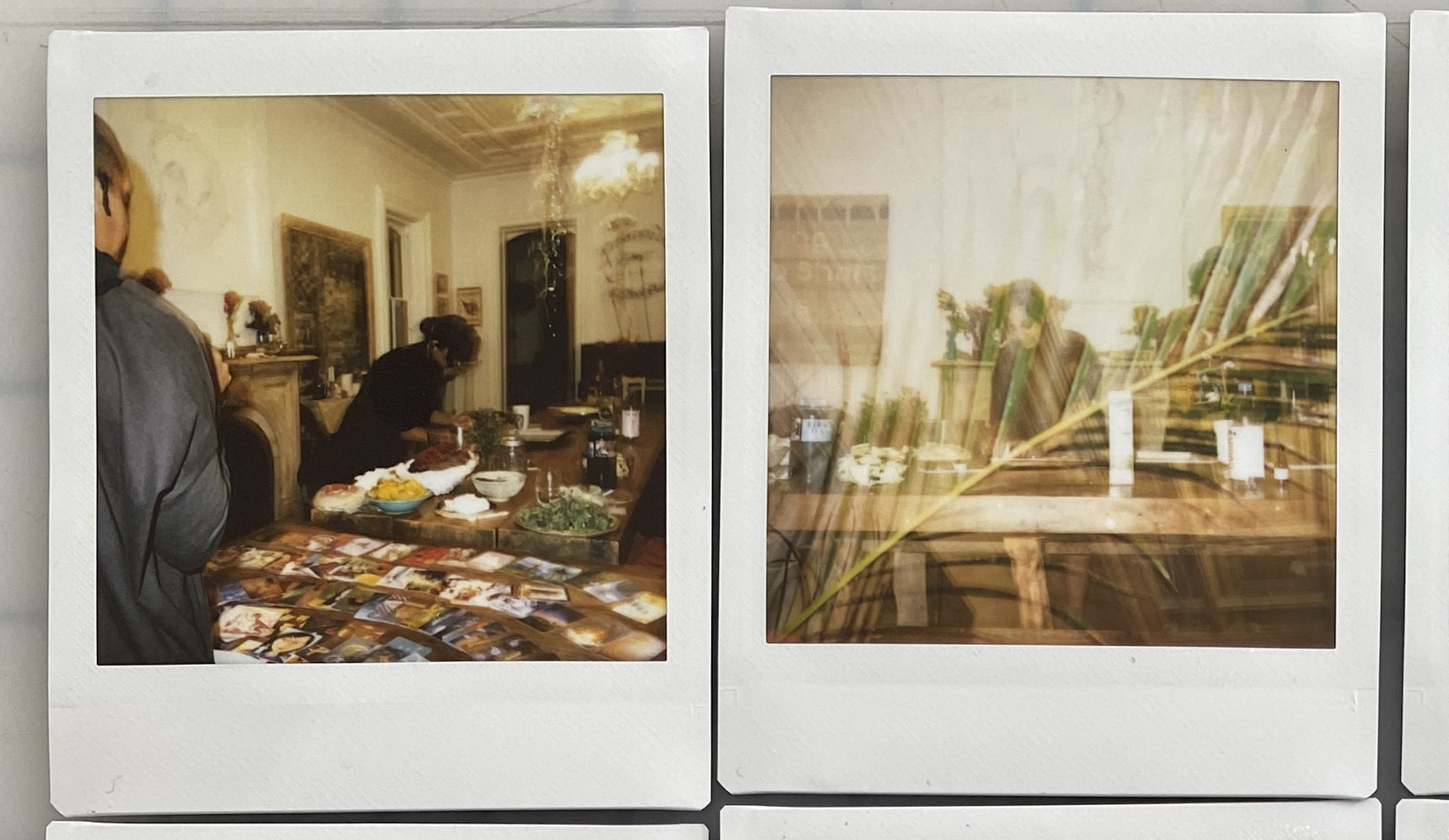


This transcript has been edited for clarity.
Sophie Weston Chien (SWC): To start us out, Sruti, can you tell me about your experience growing up as an Asian American or in Asian America? In what ways did you feel connected or disconnected to your ancestral home or homes?
Sruti Suryanarayanan (SS): I grew up in Central Jersey, which has one of the largest South Asian populations in the United States. My mom likes to joke that we’re not from South Brunswick; we’re from South Brownswick because everyone’s brown. And so there was a lot of space to actually engage with, I think, two different depths of belonging to the Asian American community and specifically the South Asian American community. One is kind of the more American political affirmation of Asian America, of Asian American identity, of Asian American community, which is panethnic, which is internationalist in approach and in values. We would go to celebrate Eid just as much as we would go and do Raas, just as much as we would enjoy the day off for Tết and try to understand how all of these things could coexist but also noticing the differences.
I think that it’s probably an eternal teenage ennui thing where you’re trying to figure out the line between belonging and alienation. And when you grow up in the States, you’re told that specifically when you’re in the Asian American, even broadly native Hawaiian Pacific Islander community, that you belong to one monolithic identity and there is no space for heterogeneity. There is no space for nuance. And I think it’s something that even within the South Asian community you’re confronted with. So even if you are in a space full of people who push against the model minority myths of prioritizing a STEM education or prioritizing a certain work-life balance or prioritizing a certain type of relationship to ancestry and elders, there is still nuances that can feel like they’re washed away.
We talk about South Asianness, and for the most part, when you talk to white people about South Asians or you talk to other Asian people about South Asians, or when you talk to broadly people of color in a united space about South Asians, they think of Indian identity, and they think of North Indian identity. And I think that’s something that I confronted a lot growing up just because my folks are from Southern India. That’s where I draw my lineage from, and it’s culturally really distinct, linguistically really distinct, and that is within the nation state of India, and beyond that, there’s so much nuance to what South Asia is.
And so I think there was simultaneously this sense of connection to a broader political identity and also a sense of dissonance where it felt like the broadest political identity didn’t necessarily capture who I was. And I think as I grew up and as my parents settled into their life, not just as South Asians but as South Asian Americans, we have kind of done this dance of figuring out how to center our Tamilness, our South Indianness, but also specifically the Dravida heritage that we draw on to almost, like—it feels like to—emphasize who we are? I’m still cooking the same things that I was cooking, but I cook them in a way that is very specific to my mother’s culinary traditions. Or when I think about political analyses, I try to root them in my own experiences of Tamil life here in the States but also of Tamil diaspora across the world. And so I think I’ve become really comfortable with feeling neither/nor and both/and, and I think it’s probably what a lot of folks in the diaspora feel.
︎audio excerpt transcript
SWC: How has being intersectionally Asian impacted the work that you do, and has it changed over time?
SS: Again, I think going back to Tyler was probably the first time that my friends who are now—we’ve all come out and reckoned with the fact that we’re not hetero and not cisgendered. And, looking back, I think that was the first moment that I actually experienced intersection between my South Asianness and the other parts of me. I think the most important thing was actually that I could recognize that there were capacities for harm in all of the communities, right? Growing up in the town that I grew up in, there were South Asians who were homophobic, and there were South Asians who were allies. There were gay folks that I was friends with who were racist, and there were gay folks who were allies. And it really made me feel like I had to go beyond just this identity-based solidarity, beyond this representation-based solidarity.
Sophie Weston Chien (SWC): To start us out, Sruti, can you tell me about your experience growing up as an Asian American or in Asian America? In what ways did you feel connected or disconnected to your ancestral home or homes?
Sruti Suryanarayanan (SS): I grew up in Central Jersey, which has one of the largest South Asian populations in the United States. My mom likes to joke that we’re not from South Brunswick; we’re from South Brownswick because everyone’s brown. And so there was a lot of space to actually engage with, I think, two different depths of belonging to the Asian American community and specifically the South Asian American community. One is kind of the more American political affirmation of Asian America, of Asian American identity, of Asian American community, which is panethnic, which is internationalist in approach and in values. We would go to celebrate Eid just as much as we would go and do Raas, just as much as we would enjoy the day off for Tết and try to understand how all of these things could coexist but also noticing the differences.
I think that it’s probably an eternal teenage ennui thing where you’re trying to figure out the line between belonging and alienation. And when you grow up in the States, you’re told that specifically when you’re in the Asian American, even broadly native Hawaiian Pacific Islander community, that you belong to one monolithic identity and there is no space for heterogeneity. There is no space for nuance. And I think it’s something that even within the South Asian community you’re confronted with. So even if you are in a space full of people who push against the model minority myths of prioritizing a STEM education or prioritizing a certain work-life balance or prioritizing a certain type of relationship to ancestry and elders, there is still nuances that can feel like they’re washed away.
We talk about South Asianness, and for the most part, when you talk to white people about South Asians or you talk to other Asian people about South Asians, or when you talk to broadly people of color in a united space about South Asians, they think of Indian identity, and they think of North Indian identity. And I think that’s something that I confronted a lot growing up just because my folks are from Southern India. That’s where I draw my lineage from, and it’s culturally really distinct, linguistically really distinct, and that is within the nation state of India, and beyond that, there’s so much nuance to what South Asia is.
And so I think there was simultaneously this sense of connection to a broader political identity and also a sense of dissonance where it felt like the broadest political identity didn’t necessarily capture who I was. And I think as I grew up and as my parents settled into their life, not just as South Asians but as South Asian Americans, we have kind of done this dance of figuring out how to center our Tamilness, our South Indianness, but also specifically the Dravida heritage that we draw on to almost, like—it feels like to—emphasize who we are? I’m still cooking the same things that I was cooking, but I cook them in a way that is very specific to my mother’s culinary traditions. Or when I think about political analyses, I try to root them in my own experiences of Tamil life here in the States but also of Tamil diaspora across the world. And so I think I’ve become really comfortable with feeling neither/nor and both/and, and I think it’s probably what a lot of folks in the diaspora feel.
︎audio excerpt transcript
SWC: Thanks for sharing. I do have a follow-up question. You mentioned your parents. Was them understanding their positionality and you understanding your positionality—did that happen at similar points, or did it happen just as a kind of maturation of whatever kind of form that is? How has that happened together and separately?
SS: I think that’s a really good question. I think for me, one of the most important moments of my life was when in Central Jersey where you are right now on the Rutgers campus, there was a gay student named Tyler Clementi, who his freshman year lived with a straight South Asian, South Indian man, boy, eighteen-year-old. And the Indian roommate was homophobic and really bullied and abused his gay roommate Tyler to the point of Tyler committing suicide. And that happened when I was in the seventh grade.
And I remember at that time my parents participated in a fundraiser to help get the Indian roommate out of prison. And at the same time, I—in my seventh grade, whatever understanding of who I was—took a vow of silence for two weeks out of anger with my parents and also out of, I think, what was purely a sense of grief and hopelessness for what so easily could have been me. And I think that felt like a point where our paths diverged.
But, when I talked to my parents, that was probably one of the first political things that they participated in because after 9/11—I mean my parents are Hindu; they’re Indian; they had lived through kind of the Dotbusters fear of the early nineties but not really been the targets of any sort of racialized Islamophobia until after 9/11, and that quelled their ability to think about political activism. And also, it really, I think, drilled into their heads that keeping your head quiet, tucking yourself under was the best way to do it. And to see them looking back, activated at this point, I think is an important moment of recognition. Though it is a point of divergence in our political paths.
But we come back together. I think 2020 was an important moment. It was right after I graduated from undergrad, and I moved back in with my parents for a couple months, and the pandemic hit soon after. And there were things that we would do in my parents’ neighborhood like mutual aid. If we knew that the nani who lived two houses down was too sick to go to Costco, we would go for her, or we would split the Apna Bazar list just so that only one person who was less immunocompromised was making the trek out into the world.
And we did other things like skill shares that actually put very, very different skills on an equal playing field, which I think helped my parents actually come to terms with their ideas of value and capital and community. It’s just as important to hear how to make the best Maggi in the world as it is to hear how to knit, as it is to hear the eight-year-old talk about his favorite Avatar: The Last Airbender fan fiction. All of those things were actually genuinely engaged with so much care and tenderness that I think it felt like a moment when my parents and I almost reunited, and when the cops murdered George Floyd in the beginning of summer, my dad joined the first protest since Tyler’s suicide. And so it felt like a good synthesis moment. And I think we’re back to a point of alignment though maybe not on all things.
SWC: How has being intersectionally Asian impacted the work that you do, and has it changed over time?
SS: Again, I think going back to Tyler was probably the first time that my friends who are now—we’ve all come out and reckoned with the fact that we’re not hetero and not cisgendered. And, looking back, I think that was the first moment that I actually experienced intersection between my South Asianness and the other parts of me. I think the most important thing was actually that I could recognize that there were capacities for harm in all of the communities, right? Growing up in the town that I grew up in, there were South Asians who were homophobic, and there were South Asians who were allies. There were gay folks that I was friends with who were racist, and there were gay folks who were allies. And it really made me feel like I had to go beyond just this identity-based solidarity, beyond this representation-based solidarity.
INTERVIEW DETAILS
Narrator:
Sruti Suryanarayanan, they/them
Interviewer:
Sophie Weston Chien, she/her
Interview Date:
April 14, 2025
Keywords:
Themes: South Asian identity, Tamil identity, non-binary identity, socioeconomic class, labor, organizing, identity politics, Solidarity Economy, mutual aid, representation-based solidarity, model minority myth, arts administration, skill sharing, interracial solidarity
Places: South Brunswick, New Jersey, Rutgers University, Southern India, New York City
References: Tyler Clementi, LeftRoots, cadrefication framework
ABOUT SRUTI
Ancestral Land:
Tamil Nadu
Homeland:
Lenapehoking (Central New Jersey)
Current Land:
Lenapehoking (Brooklyn, NY)
Diaspora Story:
In the early nineties, my father immigrated from Chennai to the U.S.—originally, Atlanta, then Santa Fe, then New Jersey—for a series of IT consulting gigs, which became a permanent position. He later married my mother, who emigrated with him to New Jersey from Cuddalore in Southern India. We moved around Central Jersey as a young family and are now settled across the tristate area.
Creative Fields:
craft (textiles, wood, metal), writing (creative non-fiction, autotheory), arts administration
Favorite Fruit:
raspberry <3
Biography:
Sruti Suryanarayanan is an Artist Organizer with Art.coop, a collective that exists to grow an arts/culture movement rooted in solidarity by centering artists and cultural workers making systems-change irresistible. Sruti is based in Brooklyn, NY, and builds systems that help people channel their culture to resist the dominant systems of racial, economic, and migration inequity. Sruti is a mentor at NEW INC, and previously organized with Cultural Solidarity Fund, Interference Archive, and South Asian Americans Leading Together (SAALT). Sruti is currently pursuing a master’s degree in Genocide Studies at the City University of New York (CUNY).
︎ ssuryana.com
︎ propogation pool
︎ remember the future fellowship
︎ @labornlove
And so I think now in the spaces that I organize, that’s really what it comes down to is that it goes beyond any identity politics into a question of action, into a question of long-term commitment and also into a space of trust. I think one of the things that when you’re one Asian American person working with another Asian American person or one South Asian American person working with another South Asian American person, there are certain contextual familiarities that you’ll have or things that you can just communicate better with one another because of that. I don’t know, it’s a type of intimacy almost similarly to how you can talk to your neighbor about what’s going on at the bodega down the street differently from your aunt who lives across the world. I think that has become the source of contention, and also the primary source of the work actually is in that space of shared identity and in that space of values that are kind of brushing up against each other. How can I use the spaces that I have access to to talk about the minute differences in our politics?
For example, if we’re all South Asians in relation to a diaspora and we’re all committed to an internationalist ethos, amazing. If we’re all committed to a Marxist analysis of the world, amazing. Maybe where we struggle is with divisions of labor in our work as organizers, or maybe where we struggle is with our analysis of solidarity outside of the South Asian American community, specifically with Black communities or Latinx, Latine communities. In that case, then I feel like my work becomes about the interrelational or the interpersonal, intrarelational—I don’t know what the right prefix is. But focusing less on the long-term presented political goals and more on the actual inner workings of relationships and politics that because of our cultural proximity, we can offer to each other with compassion but also criticality. Does that make sense? Is that clear?
SWC: Yeah, definitely! Just because I know who you are and what you do, do you want to unpack a little bit more of how this question relates to your work and organizing about labor?
For example, if we’re all South Asians in relation to a diaspora and we’re all committed to an internationalist ethos, amazing. If we’re all committed to a Marxist analysis of the world, amazing. Maybe where we struggle is with divisions of labor in our work as organizers, or maybe where we struggle is with our analysis of solidarity outside of the South Asian American community, specifically with Black communities or Latinx, Latine communities. In that case, then I feel like my work becomes about the interrelational or the interpersonal, intrarelational—I don’t know what the right prefix is. But focusing less on the long-term presented political goals and more on the actual inner workings of relationships and politics that because of our cultural proximity, we can offer to each other with compassion but also criticality. Does that make sense? Is that clear?
SWC: Yeah, definitely! Just because I know who you are and what you do, do you want to unpack a little bit more of how this question relates to your work and organizing about labor?
“...the primary source of the work actually is in that space of shared identity and in that space of values that are kind of brushing up against each other. How can I use the spaces that I have access to to talk about the minute differences in our politics?”
SS: I think that for me, a lot of the—maybe this goes back to the ideas of the model minority myth, that the good Asian American is a quiet, honest worker, a loyal worker, not a flashy worker. We’re not supposed to be at the front of the scene; we’re supposed to be in the back of the scene. And I think there’s something in there about how I really see arts administration as much as my other practices as a form of creativity because it’s a space where I can push back against tradition and also build my own. And it feels rich to think about all of the ways that my dad, but also other activists for decades prior, leveraged their power despite being in this kind of backend, back-of-house space. And that it’s also a place that’s fraught with questions of privilege and access and education feels really important. And so, trying to also crack that open. What does it look like to do budgeting work in a way that isn’t so dictated by white corporate accountants but is actually in line with the needs of the people that I’m working with?
And that goes beyond just the space of arts admin. I think about it in terms of how when you share a living space with somebody, there are a variety of chores that you all do. And one of you might be really great at cleaning the sink drain, and another might be a pro with a vacuum, but the goal of a household is to, one, yes, share those responsibilities so that the person who is good at something can do the thing that they’re good at, but also to share those skills so that if somebody feels insecure about using the vacuum, they can be trained up by somebody that they know and care about and feel cared for by, and so that they can do that. And so I think that that’s maybe how I approach the other work that I do, which is about—maybe skill sharing, but also equating?—making equal?—both offering something and needing something regardless of the type of thing that it is. Still might be vague—
Also, I work in the spaces of South Asian solidarity in New York City, meaning what does it look like for us to mobilize against settler colonialism and occupation outside of the US while also talking about the reverberations of centuries-long settler-colonial occupation here necessarily looks different. And then how does that feed into our work as tenant union organizers and as grassroots educators and as mutual aid stewards? All of those things bleed into one another. But I think at the center of it all is some sort of intimacy that we can offer—or familiarity that we can offer each other through cultural proximity, through care, through skill sharing that builds a stronger world. There’s a great framework by LeftRoots called cadrefication. I hate the name, but I love the framework, and maybe that’s something that we can put in the podcast notes.
SWC: Definitely. What do you see as your role in racial justice and solidarity work? Have you experienced resistance to your presence in racial justice or solidarity spaces?
SS: I think that the age-old isms still persist in a lot of different ways. We can talk about how patriarchy shows up in racial justice, solidarity spaces, and movement spaces. Think about who’s taking notes for meetings, think about who cooks for a meeting, think about who’s doing front-facing work at panels and who’s doing things like setting up chairs.
There’s also a lot of transphobic and other homophobic stuff that comes up. I think one of the toughest things for me has always been correcting somebody when they misgender me. And it’s something that I’ve—through talking to other people—have learned to push back on. Honestly, learning from my seven-year-old non-binary friends who are very down with telling people, like, “Hey, not a girl.” And not letting that be a point of tension, but just letting that be almost like, “I don’t eat tomatoes. This is who I am.” And so, I think those are spaces where I’ve experienced resistance. And I think internally I’ve been trying to make sense of how to live in, live through conflict despite that, because one of my favorite people of all time misgendered me for quite a moment, for a couple months, and didn’t change the fact that we got along politically on everything else. And so, when we talked about it, and she will still slip up and misgender me, there is a different type of reckoning with what our work together means because we’ve talked about that, and I think I’m starting to trust conflict as something that can be actually helpful rather than just debilitating.
And that goes beyond just the space of arts admin. I think about it in terms of how when you share a living space with somebody, there are a variety of chores that you all do. And one of you might be really great at cleaning the sink drain, and another might be a pro with a vacuum, but the goal of a household is to, one, yes, share those responsibilities so that the person who is good at something can do the thing that they’re good at, but also to share those skills so that if somebody feels insecure about using the vacuum, they can be trained up by somebody that they know and care about and feel cared for by, and so that they can do that. And so I think that that’s maybe how I approach the other work that I do, which is about—maybe skill sharing, but also equating?—making equal?—both offering something and needing something regardless of the type of thing that it is. Still might be vague—
Also, I work in the spaces of South Asian solidarity in New York City, meaning what does it look like for us to mobilize against settler colonialism and occupation outside of the US while also talking about the reverberations of centuries-long settler-colonial occupation here necessarily looks different. And then how does that feed into our work as tenant union organizers and as grassroots educators and as mutual aid stewards? All of those things bleed into one another. But I think at the center of it all is some sort of intimacy that we can offer—or familiarity that we can offer each other through cultural proximity, through care, through skill sharing that builds a stronger world. There’s a great framework by LeftRoots called cadrefication. I hate the name, but I love the framework, and maybe that’s something that we can put in the podcast notes.
SWC: Definitely. What do you see as your role in racial justice and solidarity work? Have you experienced resistance to your presence in racial justice or solidarity spaces?
SS: I think that the age-old isms still persist in a lot of different ways. We can talk about how patriarchy shows up in racial justice, solidarity spaces, and movement spaces. Think about who’s taking notes for meetings, think about who cooks for a meeting, think about who’s doing front-facing work at panels and who’s doing things like setting up chairs.
There’s also a lot of transphobic and other homophobic stuff that comes up. I think one of the toughest things for me has always been correcting somebody when they misgender me. And it’s something that I’ve—through talking to other people—have learned to push back on. Honestly, learning from my seven-year-old non-binary friends who are very down with telling people, like, “Hey, not a girl.” And not letting that be a point of tension, but just letting that be almost like, “I don’t eat tomatoes. This is who I am.” And so, I think those are spaces where I’ve experienced resistance. And I think internally I’ve been trying to make sense of how to live in, live through conflict despite that, because one of my favorite people of all time misgendered me for quite a moment, for a couple months, and didn’t change the fact that we got along politically on everything else. And so, when we talked about it, and she will still slip up and misgender me, there is a different type of reckoning with what our work together means because we’ve talked about that, and I think I’m starting to trust conflict as something that can be actually helpful rather than just debilitating.
“I really see arts administration as much as my other practices as a form of creativity because it’s a space where I can push back against tradition and also build my own. And it feels rich to think about all of the ways that my dad, but also other activists for decades prior, leveraged their power despite being in this kind of backend, back-of-house space.”
The other type of resistance is honestly just, again, classic shit. I don’t want people who aren’t people of color speaking up for us. I don’t want straight cis people speaking up for us. And I think there’s a lot of issues around class, specifically within the Asian American diaspora, that we just don’t talk about as much. All of our stories of how our people came to the states are interlocked in this economic dance that ultimately, I think, really affirm American Empire and specifically racial capitalism as a part of American Empire, and as a founding principle of American Empire. And that’s something that until we actively contend with, we’re not going to have truly non-hierarchical, truly sustainable spaces.
I think that in a lot of the spaces that I’m in, not talking about class has been the source of pain and assuming that a political analysis and a shared racial, ethnic cultural identity is enough, when the way that we come into this work really is everything. And so I think part of my role increasingly has been to think about the economics of it all, the class of it all, and to also think about what redistribution looks like because there are power dynamics in play—there are traumas that can be activated, and the work must happen regardless. I think, again, leaning away from that fear of conflict and trusting that to be a space where we can actually achieve through horizontal community feels like my role, and also maybe the role of any person in movement as much.
SWC: Any last words, last thoughts, reflections?
SS: I don’t think so. Yeah, I think it’s great. Thank you, Sophie.
I think that in a lot of the spaces that I’m in, not talking about class has been the source of pain and assuming that a political analysis and a shared racial, ethnic cultural identity is enough, when the way that we come into this work really is everything. And so I think part of my role increasingly has been to think about the economics of it all, the class of it all, and to also think about what redistribution looks like because there are power dynamics in play—there are traumas that can be activated, and the work must happen regardless. I think, again, leaning away from that fear of conflict and trusting that to be a space where we can actually achieve through horizontal community feels like my role, and also maybe the role of any person in movement as much.
SWC: Any last words, last thoughts, reflections?
SS: I don’t think so. Yeah, I think it’s great. Thank you, Sophie.
“All of our stories of how our people came to the states are interlocked in this economic dance that ultimately, I think, really affirms American Empire and specifically racial capitalism as a part of American Empire, and as a founding principle of American Empire.”
“All of our stories of how our people came to the states are interlocked in this economic dance that ultimately, I think, really affirms American Empire and specifically racial capitalism as a part of American Empire, and as a founding principle of American Empire.”
Posted March 6, 2026